- Posts: 2
- Thank you received: 0

Freezer Condensation
- Icebox
-
 Topic Author
- Offline
- New Member
-

Less
More
15 years 22 minutes ago #1105
by Icebox
Freezer Condensation was created by Icebox
I have been living on board an IP420 for over a year. The freezer constantly builds condensation on top of the counter, and inside the storage cabinets. The problem does not subside at any freezer setting. I've contacted a local marine refrigeration person who dismissed me with "That's a common Island Packet problem." The issue is becoming a bigger problem as the condensation soaks into the wood and has created a mold problem that will soon advance to rotting. I've contacted IPY Customer Service, Engineering and Design in hopes of some assistance. So far--no help.
Has anyone else experienced this problem with any other IP? Is is "fixable" without replacing the unit?
Thanks in advance for any replies.
Has anyone else experienced this problem with any other IP? Is is "fixable" without replacing the unit?
Thanks in advance for any replies.
Please Log in or Create an account to join the conversation.
- hayden
-

- Offline
- Moderator
-

14 years 11 months ago #1107
by hayden
Hayden Cochran
IP35-165 Island Spirit
IslandSpirit35.blogspot.com
Rock Hall, MD
Replied by hayden on topic Re: Freezer Condensation
Have you tried to use a simple blanket ontop of your food inside the frig or freezer. We use a basic car windshield silver bubble wrap cut to fit. This cuts down on this problem and it reduces the pace you are cooling. Some ip owners use a simple wool blanket as well.
Hayden
Hayden
Hayden Cochran
IP35-165 Island Spirit
IslandSpirit35.blogspot.com
Rock Hall, MD
Please Log in or Create an account to join the conversation.
- Icebox
-
Topic Author
- Offline
- New Member
-
Less
More
- Posts: 2
- Thank you received: 0
14 years 11 months ago #1115
by Icebox
Replied by Icebox on topic Re: Freezer Condensation
Thanks for the reply and suggestion. Had already replaced all the seals and lined the entire box with foil insulation and an insulated "blanket" top. IPY suggested all the same. Outcome: with a mirror we discovered a gap along the top edge where the freezer box comes together. The copper wiring runs along the length of this gap. We used foam insulation and with great difficulty and frustration (along with tape and cardboard) were finally able to get the foam insulation to "stick" in the gap without running down. It aint pretty!! But two days later the counter and cabinets were sweat free. The temperature did get turned down too low and sweat started to build up again. We turned up the temp and over night the sweating stopped. Seems 10 degrees is ideal for ice cream and no sweat.
Thanks again. Hope the solution will help someone else in the future.
Thanks again. Hope the solution will help someone else in the future.
Please Log in or Create an account to join the conversation.
- a Guest
-

- Visitor
-

14 years 11 months ago #1132
by a Guest
Replied by a Guest on topic Re: Freezer Condensation
We are cruisers/liveaboards on an IP38. We had similar difficulties and also tried putting a cover over the top. That isn't a solution, it's just a patch-job. The moisture indicates escaping cold air around the lid seal causing condensation when it contacts the moist exterior air. It also means air intrusion and more frost on the evaporator box. The damage is already done when you try to cover it. We solved the problem by changing the design of the top and updating the system.
The sides and bottom of our refer were about 4 /12" thick of wood and poured foam ...we drilled it to confirm that it was adequate. The top, however, was a series of "chiclet"-style plastic packets containing foam insulation. The spaces between the packets were reduced to nothing but the wooden counter top and lid. The lid itself had just one 1/2" rubber seal. There was tremendous loss of refrigerated air around the edges of the poorly-fit lid, as well as heat intrusion through the uninsulated portions of the top.
We added 4 1/2" of foam panels glued to the inside top of the box, and then covered the foam with fiberglass. We had a double-lipped, 4 1/2", vault-style lid made which provided more insulation plus two heavy rubber seals in a stair-step arrangement. The new lid has a wooden cutting board as its base, and is held with single piano-style hinge across the back. We had a 1 1/2" thick spillover divider installed. Overall we probably reduced the volume by about 3 cu.ft. We replaced the decade-old Adler Barbour with a new Technautics Cool-Blue holding plate system. If your system is fairly new, it probably isn't necessary to change it. A wrap-around evaporator plate, or a holding plate do offer easier access than a evaporator box.
We also keep a closed-cell sponge blocking the water drain to prevent any air intrusion from that direction. It has a check valve, but that doesn't really block air effectively. To pump out the box (which we rarely need to do), one must first remove the sponge.
We now have a divided, spill-over freezer/refrigerator system that cycles on its own. We maintain the freezer at about 25 degrees and the refer at around 35 degrees. We make our own ice, and we freeze fresh meats. We have absolutely NO condensation outside the box. By-the-way, we don't have an AC generator; just solar panels.
If you send us an email, we will send some photos.
The sides and bottom of our refer were about 4 /12" thick of wood and poured foam ...we drilled it to confirm that it was adequate. The top, however, was a series of "chiclet"-style plastic packets containing foam insulation. The spaces between the packets were reduced to nothing but the wooden counter top and lid. The lid itself had just one 1/2" rubber seal. There was tremendous loss of refrigerated air around the edges of the poorly-fit lid, as well as heat intrusion through the uninsulated portions of the top.
We added 4 1/2" of foam panels glued to the inside top of the box, and then covered the foam with fiberglass. We had a double-lipped, 4 1/2", vault-style lid made which provided more insulation plus two heavy rubber seals in a stair-step arrangement. The new lid has a wooden cutting board as its base, and is held with single piano-style hinge across the back. We had a 1 1/2" thick spillover divider installed. Overall we probably reduced the volume by about 3 cu.ft. We replaced the decade-old Adler Barbour with a new Technautics Cool-Blue holding plate system. If your system is fairly new, it probably isn't necessary to change it. A wrap-around evaporator plate, or a holding plate do offer easier access than a evaporator box.
We also keep a closed-cell sponge blocking the water drain to prevent any air intrusion from that direction. It has a check valve, but that doesn't really block air effectively. To pump out the box (which we rarely need to do), one must first remove the sponge.
We now have a divided, spill-over freezer/refrigerator system that cycles on its own. We maintain the freezer at about 25 degrees and the refer at around 35 degrees. We make our own ice, and we freeze fresh meats. We have absolutely NO condensation outside the box. By-the-way, we don't have an AC generator; just solar panels.
If you send us an email, we will send some photos.
Please Log in or Create an account to join the conversation.
- hayden
-
- Offline
- Moderator
-
14 years 11 months ago #1134
by hayden
Hayden Cochran
IP35-165 Island Spirit
IslandSpirit35.blogspot.com
Rock Hall, MD
Replied by hayden on topic Re: Freezer Condensation
This sounds great!
Please ADD PHOTOS into the photos links, it is really easy and you can grab a bunch of photos and add them all at once. Please share your frig photos so we can all learn how to improve ours.
Thanks
Hayden
Please ADD PHOTOS into the photos links, it is really easy and you can grab a bunch of photos and add them all at once. Please share your frig photos so we can all learn how to improve ours.
Thanks
Hayden
Hayden Cochran
IP35-165 Island Spirit
IslandSpirit35.blogspot.com
Rock Hall, MD
Please Log in or Create an account to join the conversation.
- a Guest
-
- Visitor
-
14 years 11 months ago #1135
by a Guest
Replied by a Guest on topic Re: Freezer Condensation
We have elaborated below on our earlier email about improving the refer. Attached are photos illustrating our refer project. It is not a quick solution, but it IS a permanent remedy to the moisture and heat migration.
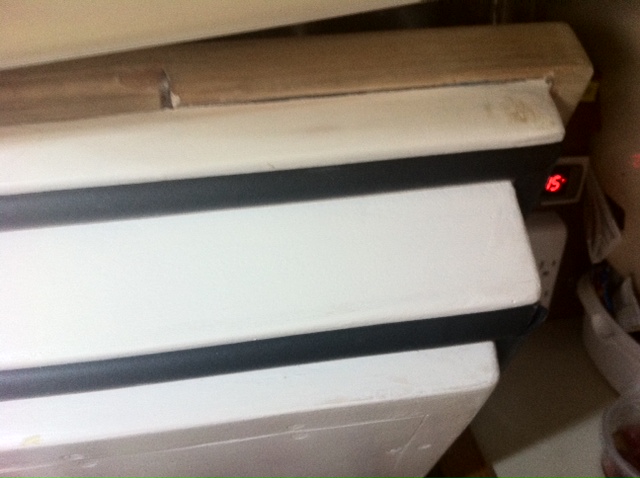
Photo 1. Shows the lid open. The old, ice-cream-box style lid used in our 1993 IP was discarded in favor of a single piano hinge style that eliminates the weakness of the middle hinge. We believe that newer IPs have already adopted a single-unit lid without a middle hinge.
Photo 2. Shows the top of the refer closed. A butcher-block cutting board was trimmed and planed to serve as strong-back for the lid. The original lid was supported just by a ~1/2" lip. The weight of the new lid would have eventually weakened that small lip. The butcher block is useful for cutting, and it supports the full weight of the new lid all the way around because it rests "on", not within, the lid opening. As with a classic butcher block, we periodically clean it with water and bleach, sand it with a block sander, and apply olive oil to keep the wood from drying out so much it cracks. The inside of the box top has elsewhere been insulated with a matching 4 1/2" of foam panels, covered with fiberglass.
Photo 3. A close-up that reveals that details of the lid with a stair-stepped edge with two large gasket edges. The lid, is 6" thick including the butcher block. The lid touches the opening frame at the bottom of the butcher block, at the first ledge, and at the second ledge. The underlying 4 3/4" of fiberglass lid is not hollow: it is completely filled with foam sheets.
Photo 4. Shows the rear frame detail, and the manner of attachment of the piano hinge. It also shows the top of the insulated, spill-over divider. The divider is NOT fiber-glassed to the sides. It is just set into place and held with wooden brackets screwed into the front and rear sides. By removing the brackets on either side, the divider can be removed to work on the box, if necessary. The wood is unfinished, and moisture does intrude into the wood a little, but only within the box.
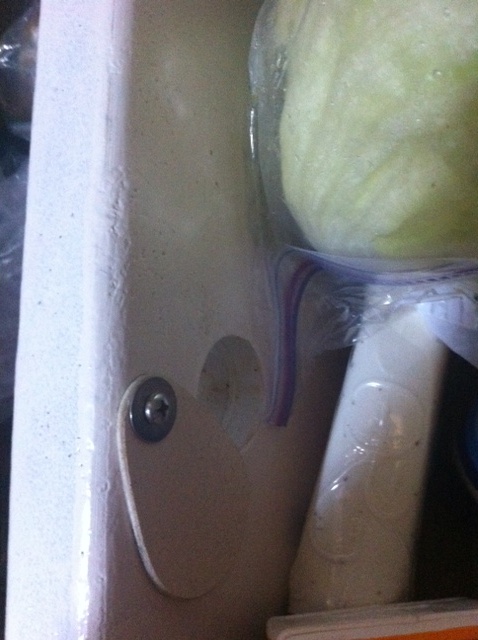
Photo 5. Shows a close-up of the upper hole and cover used to control spill over flow. A similar, but larger, hole and cover is situated in the center of the lower edge. The divider contains the air in the left side freezer(actually starboard) just enough to keep the refrigerator side from freezing.
Photo 6. Shows the digital thermostat controller. It cost an extra $250, but it is infinitely more precise than a simple twist-knob rheostat controller. It allows the operator to easily adjust the "set point" at which the unit turns off (say, 18F degrees). Less easily adjusted, but nonetheless under user control, is the upper range which establishes at what point the unit turns on (say, 7 degrees above the lower set point). The bulb of the controller will periodically be covered with ice, which over time gives rise to a difference between the reported box temperature and actual.
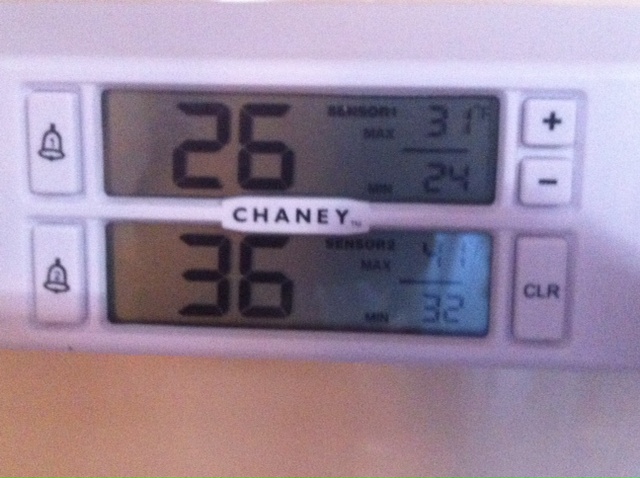
Photo 7. Shows an independent, digital, wireless, two-sensor thermometer which is useful for tracking and balancing both sides. It has no control over the unit. The sensor for the freezer side is mounted high within the freezer box so that it reports the highest temperature in the box (which must go no higher than 32F). The sensor for the refrigerator side is mounted at the lowest point in the box so that it reports the coldest temperature achieved (which should be no lower than 33F or you'll freeze your milk, etc.) This thermometer was purchased online for about $20 and includes resettable historical high and low tracking, plus an alarm which can be set to warn of too high or too low temps.
Photo 8. Shows the boat's analog ammeter reading less than 1 amp and proving that the system actually does cycle. Our earlier system, an old Adler-Barbour, never cycled and was a constant draw. We do not have an AC generator and we rely upon solar panels and a high-amperage alternator to maintain the batteries. We have achieved a freezer/refrigerator that makes ice, produces no condensation, and cycles on and off. The system uses more power when it initially comes on, and lower power as it approaches its target set point.
Photo 1. Shows the lid open. The old, ice-cream-box style lid used in our 1993 IP was discarded in favor of a single piano hinge style that eliminates the weakness of the middle hinge. We believe that newer IPs have already adopted a single-unit lid without a middle hinge.
Photo 2. Shows the top of the refer closed. A butcher-block cutting board was trimmed and planed to serve as strong-back for the lid. The original lid was supported just by a ~1/2" lip. The weight of the new lid would have eventually weakened that small lip. The butcher block is useful for cutting, and it supports the full weight of the new lid all the way around because it rests "on", not within, the lid opening. As with a classic butcher block, we periodically clean it with water and bleach, sand it with a block sander, and apply olive oil to keep the wood from drying out so much it cracks. The inside of the box top has elsewhere been insulated with a matching 4 1/2" of foam panels, covered with fiberglass.
Photo 3. A close-up that reveals that details of the lid with a stair-stepped edge with two large gasket edges. The lid, is 6" thick including the butcher block. The lid touches the opening frame at the bottom of the butcher block, at the first ledge, and at the second ledge. The underlying 4 3/4" of fiberglass lid is not hollow: it is completely filled with foam sheets.
Photo 4. Shows the rear frame detail, and the manner of attachment of the piano hinge. It also shows the top of the insulated, spill-over divider. The divider is NOT fiber-glassed to the sides. It is just set into place and held with wooden brackets screwed into the front and rear sides. By removing the brackets on either side, the divider can be removed to work on the box, if necessary. The wood is unfinished, and moisture does intrude into the wood a little, but only within the box.
Photo 5. Shows a close-up of the upper hole and cover used to control spill over flow. A similar, but larger, hole and cover is situated in the center of the lower edge. The divider contains the air in the left side freezer(actually starboard) just enough to keep the refrigerator side from freezing.
Photo 6. Shows the digital thermostat controller. It cost an extra $250, but it is infinitely more precise than a simple twist-knob rheostat controller. It allows the operator to easily adjust the "set point" at which the unit turns off (say, 18F degrees). Less easily adjusted, but nonetheless under user control, is the upper range which establishes at what point the unit turns on (say, 7 degrees above the lower set point). The bulb of the controller will periodically be covered with ice, which over time gives rise to a difference between the reported box temperature and actual.
Photo 7. Shows an independent, digital, wireless, two-sensor thermometer which is useful for tracking and balancing both sides. It has no control over the unit. The sensor for the freezer side is mounted high within the freezer box so that it reports the highest temperature in the box (which must go no higher than 32F). The sensor for the refrigerator side is mounted at the lowest point in the box so that it reports the coldest temperature achieved (which should be no lower than 33F or you'll freeze your milk, etc.) This thermometer was purchased online for about $20 and includes resettable historical high and low tracking, plus an alarm which can be set to warn of too high or too low temps.
Photo 8. Shows the boat's analog ammeter reading less than 1 amp and proving that the system actually does cycle. Our earlier system, an old Adler-Barbour, never cycled and was a constant draw. We do not have an AC generator and we rely upon solar panels and a high-amperage alternator to maintain the batteries. We have achieved a freezer/refrigerator that makes ice, produces no condensation, and cycles on and off. The system uses more power when it initially comes on, and lower power as it approaches its target set point.





Please Log in or Create an account to join the conversation.
- hayden
-
- Offline
- Moderator
-
14 years 11 months ago #1136
by hayden
Hayden Cochran
IP35-165 Island Spirit
IslandSpirit35.blogspot.com
Rock Hall, MD
Replied by hayden on topic Re: Freezer Condensation
GREAT JOB!!! I have added these photos to a photo album along with the descriptions. See photo album here:
ipyoa.com/community/62-hayden/photos/album?albumid=189
I really need to rework my lids. Thank you for your details.
Hayden
ipyoa.com/community/62-hayden/photos/album?albumid=189
I really need to rework my lids. Thank you for your details.
Hayden
Hayden Cochran
IP35-165 Island Spirit
IslandSpirit35.blogspot.com
Rock Hall, MD
Please Log in or Create an account to join the conversation.
- SeaTurtle
-
- Offline
- New Member
-
Less
More
- Posts: 1
- Thank you received: 0
10 years 8 months ago #4666
by SeaTurtle
Replied by SeaTurtle on topic Freezer Condensation
We have an Estero. Freezer moisture is a major problem. Besides condensation on the surface, there is MAJOR condensation above the drawer just under the refrigerator particularly in the corner next to the freezer. Water collects and drips into the drawer. As mentioned in another post, this is a setup for mold and rotting of the wood. Other than a complete rebuild of the unit, is there a cause and possible solution?
Please Log in or Create an account to join the conversation.
- Augydoggy
-

- Offline
- Premium Member
-

Less
More
- Posts: 147
- Thank you received: 12
10 years 8 months ago #4668
by Augydoggy
Replied by Augydoggy on topic Freezer Condensation
Sea Turtle - the original post was by "Icebox", my wife. In 2012 we remodeled the galley which included a new countertop. When the old counter was removed we found a 2" gap in the foam insulation on the starboard side of the freezer. This is the area we were having problems with condensation. We filled the gap, finished the galley, and have enjoyed no condensation buildup since. Based on this I would suggest your problem is air gaps in the insulation around the freezer. I'm not familiar with the layout of the Estero but if it's like our 420 the only way to fill the gaps is to remove the countertop. If your freezer is as big as ours then maybe a good solution would be to add insulation panels inside the box. Even with living aboard we could get by with about half the space in our freezer. And that's leaving room for ice cream!
Tom & Cheri (Icebox)
IP420-35
La Vida Dulce
Tom & Cheri (Icebox)
IP420-35
La Vida Dulce
Please Log in or Create an account to join the conversation.
Time to create page: 0.265 seconds
We have 2812 guests and no members online
Disclaimer
Island Packet and Island Packet Yachts are registered trademarks of IPY (Island Packet Yachts, Inc.). IPYOA and The Island Packet Yacht Owners Association, have no affiliation with IPY, the Island Packet Yacht Company. Throughout our IPYOA Facebook Group and on this IPYOA.com website the terms Island Packet and Island Packet Yachts are used for identification purposes only. This use is FAIR USE and NOMINATIVE. We are NOT a yacht manufacturer we are a yacht owners group.
Sincerely,
The International IPYOA administration team.