- Posts: 1
- Thank you received: 1

Walt Scott and the Quiet Origins of Island Packet
- shadscott
-
 Topic Author
- Offline
- New Member
-

Less
More
5 months 6 days ago - 5 months 6 days ago #7578
by shadscott
Walt Scott and the Quiet Origins of Island Packet was created by shadscott
Walt Scott and the Quiet Origins of Island Packet
How a designer most IP owners have never heard of drew the hull that launched the company
If you own an Island Packet, the name on the design plate is Robert K. Johnson. That has been true for nearly fifty years, and there's good reason for it. Bob Johnson founded the company, drew the boats, and built Island Packet into one of the most respected names in American offshore cruising. His name belongs on those plates.
But the very first Island Packet — the boat that started everything — also carries the fingerprints of another designer. His name was Walter Scott, he was a friend and colleague of Bob's, and he has been gone for a long time now. Most IP owners I talk to have never heard of him. I would not have either, except that my first boat happened to be one of his.
I sail an Island Packet 465 named Delphi. Before her, I owned — and still own — a 1979 Bombay Clipper 31 named Ellie Mae II. The Bombay is a Walt Scott design. Living with that boat and digging into her history pulled me deep into the 1970s Florida boatbuilding scene — the Tampa Bay yards, the designers and plant managers who rotated between them, and the broader tradition of conservative, beamy, full-keel cruisers that Florida was quietly producing during a decade better remembered for other things. By the time I was ready to step up to a larger boat, the choice was not random. The Island Packet 465 was the logical next move: same designer bloodline, same Tampa Bay tradition, same state of origin. The history was a meaningful part of why I bought her.
This article is what I learned about the man who connects those two boats, and why I think he deserves more recognition than he has gotten.
The Tampa Bay Scene
To understand where Walt Scott came from, you have to back up to Irwin Yachts in Clearwater, Florida, in the early-to-mid 1970s. Irwin was one of three major production yards in the Tampa Bay area at the time — alongside Morgan and Gulfstar — and a remarkable number of the people who shaped American cruising sailboats over the next three decades passed through that building.
Walt Scott was a staff designer at Irwin. Bob Johnson — MIT-trained naval architect, fresh from a stint at McDonnell Douglas and a surfboard venture in California — joined Irwin in 1974 as a naval architect and would soon become production manager. Bob and Walt worked alongside each other for the next couple of years, and according to Bob's own later recollections, they became close friends.
Two other Irwin people, Ross James (production manager) and Chris Petty (sales manager), broke off in the mid-1970s to start their own yard: Bombay Yachts (formally New Bombay Trading Co.). They hired their friend Walt Scott as their designer.
What Walt Drew
Walt designed two boats for Bombay that matter to this story.
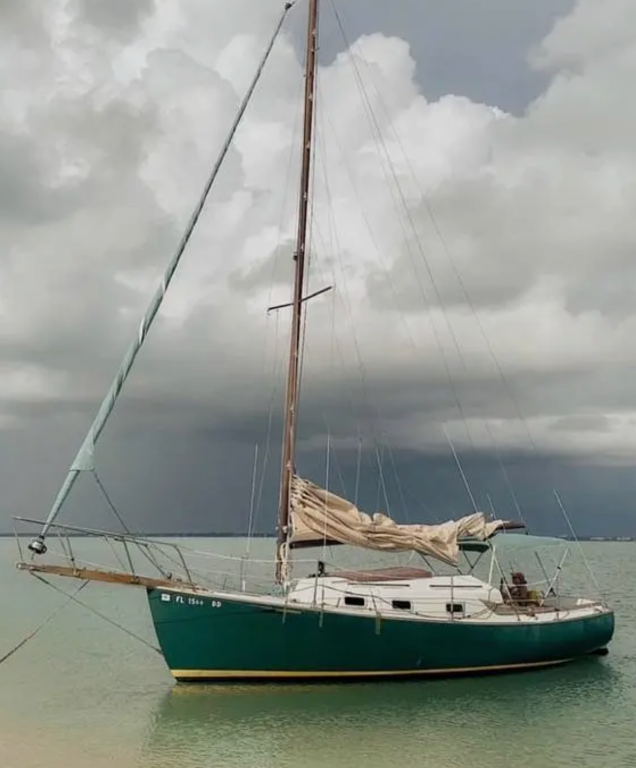
The first was the Bombay Clipper 31, drawn from a clean sheet and first built in 1975. She's a beamy, heavily built, shoal-draft masthead sloop — 31 feet on deck, 11-foot beam, 10,000 pounds displacement, draft of 3 feet 5 inches in the shoal-keel version. Yanmar and Perkins 3-cylinder diesels both appear in the production runs — mine is a Perkins. The Clipper 31 stayed in production after Bombay closed; Chaparral, a Georgia powerboat builder, picked up the molds for additional hulls.
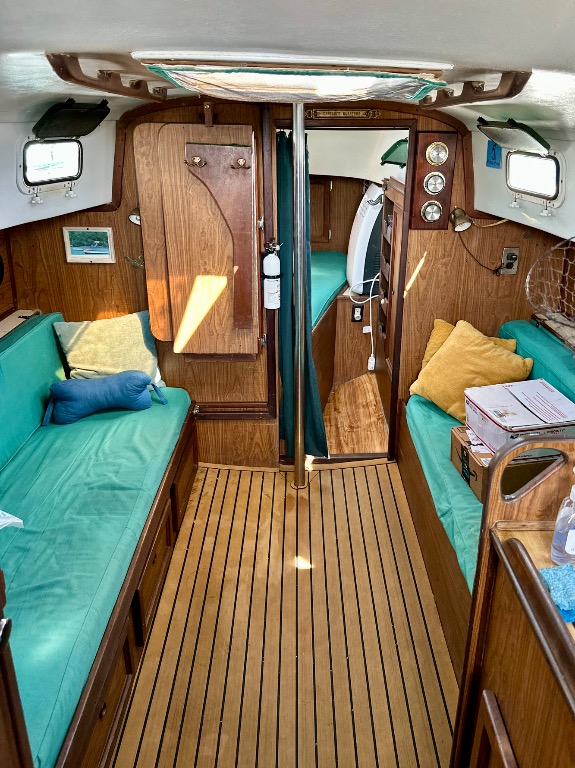
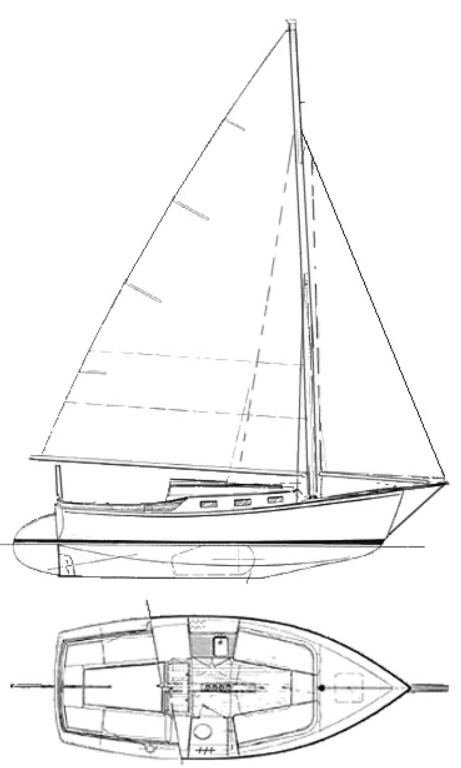
The second Walt design — the one that matters most for Island Packet history — was the Bombay Express 26, drawn in 1978. She was a small, beamy cat-sloop with a barn-door rudder, a short bowsprit carrying a small jib, and 5 feet 9 inches of headroom — remarkable for a boat under 30 feet. The design pulled from Alden's 1930s cat-sloop work and from the Irwin 10-4, which Chris Petty had championed during his Irwin days. The Bombay Express was Walt's expression of an idea Chris had been chasing for years: a beamy pocket cruiser with the livability of a much larger boat.
Bombay didn't make it long enough to see what the Express 26 could have become. The company's investor passed away around 1979, the operation was liquidated, and the molds — for both the Clipper 31 and the Express 26 — were sold off. There were no published production totals, but the Bombay Express had been in production for only about nine months.
The Founding of Island Packet
Bob Johnson had moved on from Irwin a few years earlier, going first to Endeavour Yachts in Clearwater as designer and plant manager. By 1979 he was ready to start his own company. He incorporated Traditional Watercraft, Inc. in Largo, Florida — the legal name Island Packet operates under to this day — and began looking for a first model to launch with.
He bought his friend Walt's Bombay Express 26 molds out of the Bombay liquidation.
Starting in 1980, Bob produced that hull, with his own modifications, simply as the "Island Packet." It went on sale from his kitchen telephone, with construction contracted out to a local boat builder. As orders grew, Traditional Watercraft brought construction in-house, and after about thirty hulls the company began expanding into larger cruising sailboats.
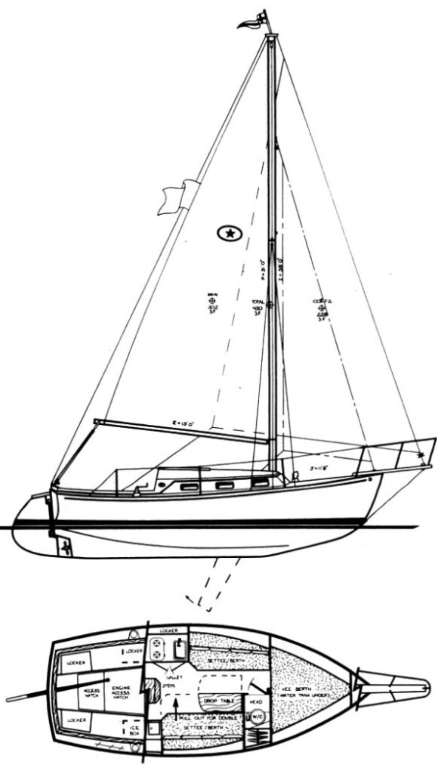
Today that first model is known as the Island Packet 26 Mk I. The sailboatdata registry credits it as a co-design by Walter Scott and Robert K. Johnson, because that is what it was. Walt's beamy cat-sloop hull, with Bob's modifications and his name on the company door.
Every subsequent Island Packet — the 26 Mk II, the 27, the 31, the 32, the 35, the 38, the 40, the 380, the 420, the 485, my 465, and on through the rest of the line — traces its design lineage back to a Walter Scott hull. Not as a copy, but as a starting point. The beamy, generous-volume, conservative-layup philosophy that defines the Island Packet brand to this day has its origins in a design Walt drew for a small Florida yard that didn't survive its own investor's death.
A Quiet Acknowledgment
The most direct acknowledgment of Walt's role in Island Packet's founding came from Bob Johnson himself, in a long and generous interview he gave to Good Old Boat magazine in October 2004. In that interview, Bob walks through his entire career — McDonnell Douglas, Hollow Wave surfboards, Irwin, Endeavour, Traditional Watercraft — and when the conversation turns to Walt, he says simply that Walt was "a good friend who's passed on now."
That is the only published acknowledgment I have been able to find, in print, of Walt Scott's passing. There is no obituary I can locate. There is no Walter Scott memorial page on the Island Packet website. There is no Wikipedia article. The fullest record of his life as a yacht designer exists in scattered sailboatdata listings for the two Bombay models he drew, and in the recollections Bob Johnson shared with Good Old Boat twenty-two years ago.
It is a quiet acknowledgment for a designer whose work shaped a company that has now built more than 2,500 yachts and earned the loyalty of one of the most devoted owner groups in American sailing.
What's Still in Every IP
There is a useful parallel from outside the sailing world. Porsche has built the 911 in continuous production since 1964 — more than sixty years, across eight generations. The car has been refined and re-engineered repeatedly; almost no individual component on a 2026 911 carries over from the original. And yet the 911 of today is unmistakably the same car as the 911 of 1964. The silhouette, the proportions, the rear-engine layout, the philosophical commitments — all carry forward. Porsche has resisted enormous pressure over the decades to reinvent the 911; every time they have flirted with major departures, they have returned to the original DNA. It is what makes a 911 a 911.
Island Packet has done the same thing, in fiberglass and on water. From the Walt Scott / Bob Johnson 26 Mk I in 1980 to the IP 465 in 2008 and every model since, every Island Packet is unmistakably an Island Packet. The beam, the conservative layup, the shallow draft, the full-keel philosophy — Bob Johnson refined and scaled the formula across nearly fifty years of designs, but he never abandoned it. Owners do not want a reinvention. They want the next refinement of the same boat.
The parallel goes deeper than design philosophy. Ferdinand "Butzi" Porsche, who drew the original 911, passed away in 2012. His original concept has outlived him by more than a decade, carried forward by the engineers and designers who came after him. Walt Scott drew the hull (as the Bombay Express 26) in 1978 that became the first Island Packet two years later. Walt is also gone now. Bob Johnson has carried that hull's philosophy forward for the next forty-five years. In both cases, the line continues without its originating designer because the underlying idea was right the first time.
A 1978 Bombay Express 26 and a 2008 Island Packet 465 are, on the surface, very different boats. Mine is more than twice as long, more than three times the displacement, and a fundamentally different mission profile. But the DNA carries.
Beamy for length. Generous interior volume prioritized over sleek looks. Heavy, conservative hand-laid layup. Shallow draft as a design priority rather than an afterthought. Forgiving, deliberate manners under sail — not fast, never tender. The cat-sloop proportions that Walt drew for a small Florida yard in 1978 still inform what an Island Packet feels like in 2026.
Stand on the dock at any IP rendezvous and you can find Walt's fingerprints if you know where to look.
A Note from Both Sides of the Family
I am one of a very small group of sailors who have owned both a Walter Scott design and a Bob Johnson design. Ellie Mae II is still mine, still in Florida, and the Perkins still starts. Delphi carries me now. When I sit at Delphi's nav station and look at the way the saloon is laid out, the headroom, the beam — and then I think back to Ellie Mae's cabin, with the same generous proportions in a smaller package — the family resemblance is unmistakable.
I do not want this article to take anything away from Bob Johnson. He built Island Packet. He drew every boat from the 26 Mk II forward. He created a company that has supported some of the best cruising of the last forty years. His name belongs on those design plates, and on the trophies, and on the history.
I just think there is room next to it, in the family record, for the name of the friend who drew the first hull. Walter Scott drew the boat that started everything, and he deserves to be remembered for it.
What Do You Know?
I pieced this together from Bob Johnson's 2004 Good Old Boat interview, sailboatdata, period brochures, and conversations with other owners. I am sure there are gaps.
If you knew Walt personally — or worked at Bombay, Irwin, Endeavour, or any of the Tampa Bay yards in that era — I would love to hear from you. If you own a Bombay Clipper 31, a Bombay Express 26, or an early-hull Island Packet 26 Mk I, the same. If you have brochures, photos, documents, or stories from that scene, post them in this thread or send them my way.
This is the article's first draft, not its last. Help me make it better.
— Shad
www.poopdeck.net
How a designer most IP owners have never heard of drew the hull that launched the company
If you own an Island Packet, the name on the design plate is Robert K. Johnson. That has been true for nearly fifty years, and there's good reason for it. Bob Johnson founded the company, drew the boats, and built Island Packet into one of the most respected names in American offshore cruising. His name belongs on those plates.
But the very first Island Packet — the boat that started everything — also carries the fingerprints of another designer. His name was Walter Scott, he was a friend and colleague of Bob's, and he has been gone for a long time now. Most IP owners I talk to have never heard of him. I would not have either, except that my first boat happened to be one of his.
I sail an Island Packet 465 named Delphi. Before her, I owned — and still own — a 1979 Bombay Clipper 31 named Ellie Mae II. The Bombay is a Walt Scott design. Living with that boat and digging into her history pulled me deep into the 1970s Florida boatbuilding scene — the Tampa Bay yards, the designers and plant managers who rotated between them, and the broader tradition of conservative, beamy, full-keel cruisers that Florida was quietly producing during a decade better remembered for other things. By the time I was ready to step up to a larger boat, the choice was not random. The Island Packet 465 was the logical next move: same designer bloodline, same Tampa Bay tradition, same state of origin. The history was a meaningful part of why I bought her.
This article is what I learned about the man who connects those two boats, and why I think he deserves more recognition than he has gotten.
The Tampa Bay Scene
To understand where Walt Scott came from, you have to back up to Irwin Yachts in Clearwater, Florida, in the early-to-mid 1970s. Irwin was one of three major production yards in the Tampa Bay area at the time — alongside Morgan and Gulfstar — and a remarkable number of the people who shaped American cruising sailboats over the next three decades passed through that building.
Walt Scott was a staff designer at Irwin. Bob Johnson — MIT-trained naval architect, fresh from a stint at McDonnell Douglas and a surfboard venture in California — joined Irwin in 1974 as a naval architect and would soon become production manager. Bob and Walt worked alongside each other for the next couple of years, and according to Bob's own later recollections, they became close friends.
Two other Irwin people, Ross James (production manager) and Chris Petty (sales manager), broke off in the mid-1970s to start their own yard: Bombay Yachts (formally New Bombay Trading Co.). They hired their friend Walt Scott as their designer.
What Walt Drew
Walt designed two boats for Bombay that matter to this story.
The first was the Bombay Clipper 31, drawn from a clean sheet and first built in 1975. She's a beamy, heavily built, shoal-draft masthead sloop — 31 feet on deck, 11-foot beam, 10,000 pounds displacement, draft of 3 feet 5 inches in the shoal-keel version. Yanmar and Perkins 3-cylinder diesels both appear in the production runs — mine is a Perkins. The Clipper 31 stayed in production after Bombay closed; Chaparral, a Georgia powerboat builder, picked up the molds for additional hulls.
The second Walt design — the one that matters most for Island Packet history — was the Bombay Express 26, drawn in 1978. She was a small, beamy cat-sloop with a barn-door rudder, a short bowsprit carrying a small jib, and 5 feet 9 inches of headroom — remarkable for a boat under 30 feet. The design pulled from Alden's 1930s cat-sloop work and from the Irwin 10-4, which Chris Petty had championed during his Irwin days. The Bombay Express was Walt's expression of an idea Chris had been chasing for years: a beamy pocket cruiser with the livability of a much larger boat.
Bombay didn't make it long enough to see what the Express 26 could have become. The company's investor passed away around 1979, the operation was liquidated, and the molds — for both the Clipper 31 and the Express 26 — were sold off. There were no published production totals, but the Bombay Express had been in production for only about nine months.
The Founding of Island Packet
Bob Johnson had moved on from Irwin a few years earlier, going first to Endeavour Yachts in Clearwater as designer and plant manager. By 1979 he was ready to start his own company. He incorporated Traditional Watercraft, Inc. in Largo, Florida — the legal name Island Packet operates under to this day — and began looking for a first model to launch with.
He bought his friend Walt's Bombay Express 26 molds out of the Bombay liquidation.
Starting in 1980, Bob produced that hull, with his own modifications, simply as the "Island Packet." It went on sale from his kitchen telephone, with construction contracted out to a local boat builder. As orders grew, Traditional Watercraft brought construction in-house, and after about thirty hulls the company began expanding into larger cruising sailboats.
Today that first model is known as the Island Packet 26 Mk I. The sailboatdata registry credits it as a co-design by Walter Scott and Robert K. Johnson, because that is what it was. Walt's beamy cat-sloop hull, with Bob's modifications and his name on the company door.
Every subsequent Island Packet — the 26 Mk II, the 27, the 31, the 32, the 35, the 38, the 40, the 380, the 420, the 485, my 465, and on through the rest of the line — traces its design lineage back to a Walter Scott hull. Not as a copy, but as a starting point. The beamy, generous-volume, conservative-layup philosophy that defines the Island Packet brand to this day has its origins in a design Walt drew for a small Florida yard that didn't survive its own investor's death.
A Quiet Acknowledgment
The most direct acknowledgment of Walt's role in Island Packet's founding came from Bob Johnson himself, in a long and generous interview he gave to Good Old Boat magazine in October 2004. In that interview, Bob walks through his entire career — McDonnell Douglas, Hollow Wave surfboards, Irwin, Endeavour, Traditional Watercraft — and when the conversation turns to Walt, he says simply that Walt was "a good friend who's passed on now."
That is the only published acknowledgment I have been able to find, in print, of Walt Scott's passing. There is no obituary I can locate. There is no Walter Scott memorial page on the Island Packet website. There is no Wikipedia article. The fullest record of his life as a yacht designer exists in scattered sailboatdata listings for the two Bombay models he drew, and in the recollections Bob Johnson shared with Good Old Boat twenty-two years ago.
It is a quiet acknowledgment for a designer whose work shaped a company that has now built more than 2,500 yachts and earned the loyalty of one of the most devoted owner groups in American sailing.
What's Still in Every IP
There is a useful parallel from outside the sailing world. Porsche has built the 911 in continuous production since 1964 — more than sixty years, across eight generations. The car has been refined and re-engineered repeatedly; almost no individual component on a 2026 911 carries over from the original. And yet the 911 of today is unmistakably the same car as the 911 of 1964. The silhouette, the proportions, the rear-engine layout, the philosophical commitments — all carry forward. Porsche has resisted enormous pressure over the decades to reinvent the 911; every time they have flirted with major departures, they have returned to the original DNA. It is what makes a 911 a 911.
Island Packet has done the same thing, in fiberglass and on water. From the Walt Scott / Bob Johnson 26 Mk I in 1980 to the IP 465 in 2008 and every model since, every Island Packet is unmistakably an Island Packet. The beam, the conservative layup, the shallow draft, the full-keel philosophy — Bob Johnson refined and scaled the formula across nearly fifty years of designs, but he never abandoned it. Owners do not want a reinvention. They want the next refinement of the same boat.
The parallel goes deeper than design philosophy. Ferdinand "Butzi" Porsche, who drew the original 911, passed away in 2012. His original concept has outlived him by more than a decade, carried forward by the engineers and designers who came after him. Walt Scott drew the hull (as the Bombay Express 26) in 1978 that became the first Island Packet two years later. Walt is also gone now. Bob Johnson has carried that hull's philosophy forward for the next forty-five years. In both cases, the line continues without its originating designer because the underlying idea was right the first time.
A 1978 Bombay Express 26 and a 2008 Island Packet 465 are, on the surface, very different boats. Mine is more than twice as long, more than three times the displacement, and a fundamentally different mission profile. But the DNA carries.
Beamy for length. Generous interior volume prioritized over sleek looks. Heavy, conservative hand-laid layup. Shallow draft as a design priority rather than an afterthought. Forgiving, deliberate manners under sail — not fast, never tender. The cat-sloop proportions that Walt drew for a small Florida yard in 1978 still inform what an Island Packet feels like in 2026.
Stand on the dock at any IP rendezvous and you can find Walt's fingerprints if you know where to look.
A Note from Both Sides of the Family
I am one of a very small group of sailors who have owned both a Walter Scott design and a Bob Johnson design. Ellie Mae II is still mine, still in Florida, and the Perkins still starts. Delphi carries me now. When I sit at Delphi's nav station and look at the way the saloon is laid out, the headroom, the beam — and then I think back to Ellie Mae's cabin, with the same generous proportions in a smaller package — the family resemblance is unmistakable.
I do not want this article to take anything away from Bob Johnson. He built Island Packet. He drew every boat from the 26 Mk II forward. He created a company that has supported some of the best cruising of the last forty years. His name belongs on those design plates, and on the trophies, and on the history.
I just think there is room next to it, in the family record, for the name of the friend who drew the first hull. Walter Scott drew the boat that started everything, and he deserves to be remembered for it.
What Do You Know?
I pieced this together from Bob Johnson's 2004 Good Old Boat interview, sailboatdata, period brochures, and conversations with other owners. I am sure there are gaps.
If you knew Walt personally — or worked at Bombay, Irwin, Endeavour, or any of the Tampa Bay yards in that era — I would love to hear from you. If you own a Bombay Clipper 31, a Bombay Express 26, or an early-hull Island Packet 26 Mk I, the same. If you have brochures, photos, documents, or stories from that scene, post them in this thread or send them my way.
This is the article's first draft, not its last. Help me make it better.
— Shad
www.poopdeck.net
Attachments:
Last edit: 5 months 6 days ago by shadscott.
The following user(s) said Thank You: capthurls
Please Log in or Create an account to join the conversation.
- hayden
-

- Offline
- Moderator
-

2 months 2 weeks ago #7588
by hayden
Hayden Cochran
IP35-165 Island Spirit
IslandSpirit35.blogspot.com
Rock Hall, MD
Replied by hayden on topic Walt Scott and the Quiet Origins of Island Packet
Shad:
Fantastic article, and I really appreciate this. I have been here since 1986 chartering IPs in Rock Hall, MD. In 1991, I bought IP27-84 and sailed her for a decade, then in 2001 I bought IP35-165 and now have sailed her for 26 years and am still going, www.svIslandSpirit.com
My lifetime passion is IPY and I know much of the history from 1986 onward, but this historical background is really fantastic. GREAT JOB.
You need to send this to the factory as well, and maybe they can add it to their site also.
Thank you very much for this writing.
Hayden
Fantastic article, and I really appreciate this. I have been here since 1986 chartering IPs in Rock Hall, MD. In 1991, I bought IP27-84 and sailed her for a decade, then in 2001 I bought IP35-165 and now have sailed her for 26 years and am still going, www.svIslandSpirit.com
My lifetime passion is IPY and I know much of the history from 1986 onward, but this historical background is really fantastic. GREAT JOB.
You need to send this to the factory as well, and maybe they can add it to their site also.
Thank you very much for this writing.
Hayden
Hayden Cochran
IP35-165 Island Spirit
IslandSpirit35.blogspot.com
Rock Hall, MD
Please Log in or Create an account to join the conversation.
Time to create page: 0.418 seconds
We have 2051 guests and no members online
Disclaimer
Island Packet and Island Packet Yachts are registered trademarks of IPY (Island Packet Yachts, Inc.). IPYOA and The Island Packet Yacht Owners Association, have no affiliation with IPY, the Island Packet Yacht Company. Throughout our IPYOA Facebook Group and on this IPYOA.com website the terms Island Packet and Island Packet Yachts are used for identification purposes only. This use is FAIR USE and NOMINATIVE. We are NOT a yacht manufacturer we are a yacht owners group.
Sincerely,
The International IPYOA administration team.