A trip to Banco Chinchorro became compelling when I learned that my Puerto Morelos dive guide Juaquin could obtain government permission for a trip that would allow extensive freedom within, and access to, the Banco Chinchorro biosphere. His wife worked for the Mexican interior department with jurisdiction over this protected and generally off-limits area. Banco Chinchorro is an atoll rising out of the Carribean sea 50-70 Miles off the Yucatan coast @ the lattitude of Mexico's southern border w/ Belize.
From Isla, Banco Chinchorro is about 180 miles south. The first leg from Isla ended at El Cid Marina, Puerto Morelos, where I added Juaquin and Marc. (Marc started my Isla Mujeres experience when I first visited his new Puerto Morelos house.)
The trip down was 44 hours from Puerto Morelos, upwind and up current. It was midnight, without any ambient light, when we arrived at the entrance into the interior of the atoll. We entered at a very slow speed and felt our way to the restricted mooring field, (3 mooring balls). We were aided by the Mexican Navy, in a typical panga, who are on you immediately as you approach.
We were able to stay for a week with our letter of permission. All other boats entering are immediately intercepted by the navy who advise they can tie to the mooring, stay for the night only, and are confined to their vessel (they are not allowed to put a toe in the water!)
We visited all 3 keys, Cayo Norte, where the Mexican Navy has a station, Cayo Central where the Guarda de Parque has their station, and Cayo Lobos, uninhabited and unimproved except for an aluminum frame lighthouse. Cayo Lobo was remote, unspoiled, and a nesting site for seagulls who lay their eggs on the open sand, where they incubate from the sun's heat. We dove a nearby pristine reef. It had a tremendous variety of life!
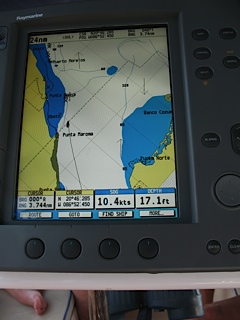
The sail back was 28 hrs from Cayo Central to Isla including a short stop at Puerto Morelos. Downwind and down current I saw a top speed of 10.4 SOG!
Photos:
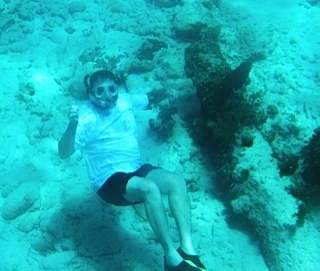
What a fabulous dive! Quarenta Canones, (40 cannons) all that remains of a Dutch galleon claimed by the dangerous Banco Chinchorro reef, circa 1600's, the final repose for hundreds of unlucky vessels. Marc poses alongside one of the canons (28 remain) scattered on the ocean floor.
The lighthouse on the NW corner of Cayo Norte.
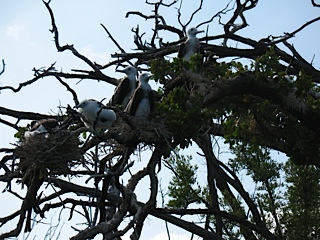
We explored an inner lagoon which is a rookery for frigate birds, aves frigates, as tame and calm as Galopagos' wildlife.
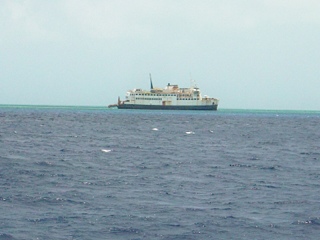
The large vessel last sailed as a ferry from Cancun to Cozumel. Its captain's strategy for riding out Hurricane Wilma, 2005, at sea didn't work out. It is firmly parked on the Banco Chinchorro reef.
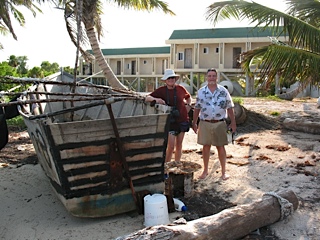
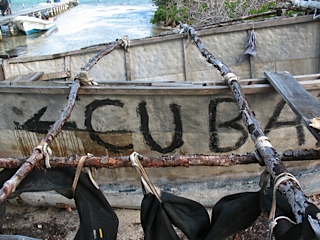
A homemade vessel that washed up on Cayo Central. The "Cuba" lettering had the direction arrow pointed to the stern of the vessel, indicating that it transported Cuban refugees fleeing Castro in 2005. I have seen these homemade craft in Isla Mujeres, too. One can sit, focus on these vessels and feel overwhelmed, admiring the guts of anyone willing to set to sea in such a craft determined to make an uncertain, risky passage to freedom.
George Henry
S/V Andromeda, IP44-35,
Isla Mujeres, Mexico