

Complete Refer Refit
Wednesday - December 31, 2008•Views: 5121••
Over the summer I did a complete refer/freezer box refit. Last season in the Carib we were using 100-120 amps/day for the fridge/freezer. We reused the same system - a Glacier Bay MicroHPS Hybrid unit - and are now using 40-50 amps/day.
The two primary design decisions were a) whether to try to reinsulate the box in place vs. ripping the whole thing out, and b) whether or not to use vacuum panels. After much research and thought I decided to rip the whole thing out and NOT to use vacuum panels. I just didn't think that I could do a professional quality job without gutting the whole thing and removing the cabinets and countertop. As for the vacuum panels, after looking at a number of studies and talking to two different manufacturers I just couldn't justify installing them due to poor quality control and a lack of longevity. Even Glacier Bay, almost certainly the best VIP manufacturer out there, admits that you're not likely to get more than 5 years out of their panels. Due to the poor quality control, I wasn't confident that 6 months out I could count on more than R-9 per inch with VIPs, compared with R-5 with extruded polystyrene (pinkboard). The EPS is infinitely easier to work with, making designing the box much simpler, not to mention MUCH cheaper. We had enough room for 6 inches in the freezer and 4+ in the fridge, so I went with the EPS.
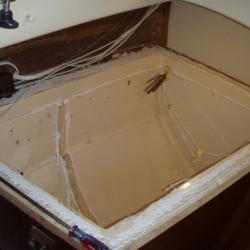
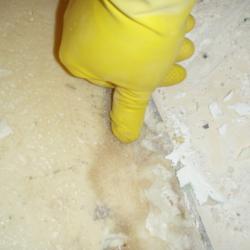
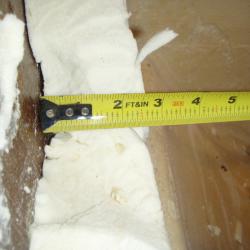
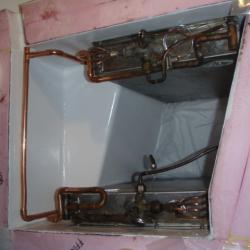
I removed the all the cabinets and countertop, removed the holding plates and plumbing, and cut out the old fiberglass icebox liner which had been reused for the previous installation. Removing the cabinets and countertop wasn't difficult at all, and I can't imagine trying to do this job without having done that. The pour-in-place factory foam didn't have too much in the way of voids, but there were significant problems. The first was that IP didn't get the liner centered in the cabinet before pouring the foam. The result was that the wall between our freezer and the stove/oven had only 2-3" of insulation. The second was that enough condensation and leakage (through screw holes) had collected that the foam was soaking wet (see pictures). All told, I estimate that the average R value of the freezer and fridge were R-10 at most. No wonder we were using so much power!
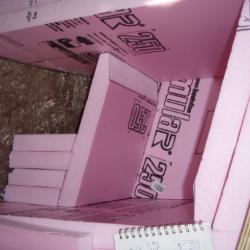
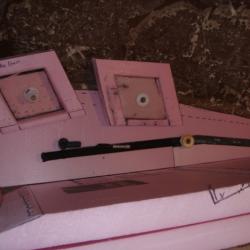
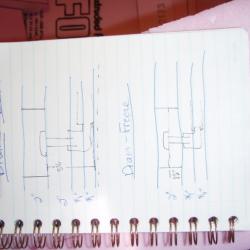
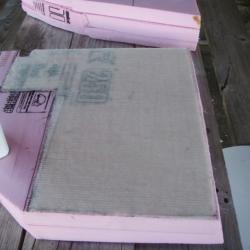
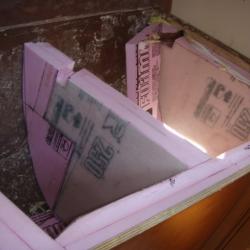
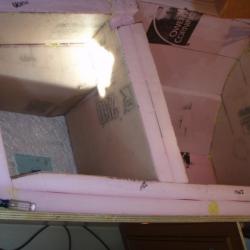
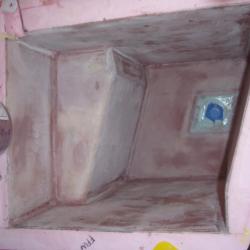
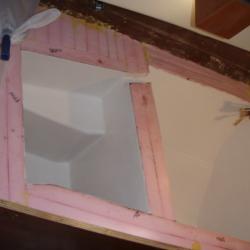
I scribed and cut the EPS, assembling it into "modules" that could then be removed from the boat and fiberglassed on the exposed areas. Once back in the boat I then only had to fillet and fair the seams, and then sand/prime/paint. It went very smoothly and exactly to plan, but make no mistake this was a HUGE job - I had more than 150 hours in it. The installation was complicated by the fact that I incorporated a drain into each side. It was also complicated by the fact that I reused the large holding plates for the freezer - in hindsight I should have ordered new plates in a smaller size.
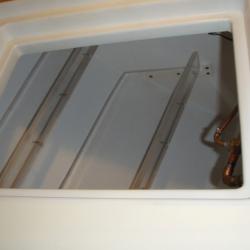
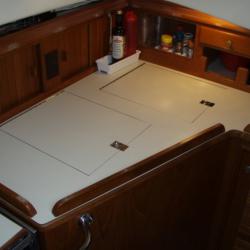
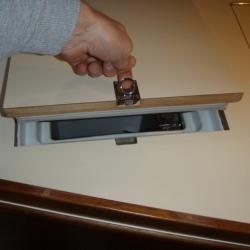
The freezer is about 1/3 smaller than it was previously, but the usable space is about the same. The fridge is about 25% smaller, but the usable area is nearly double due to the arrangement of the new shelving. As I mentioned, the system is the Glacier Bay MicroHPS system. The lids are also Glacier Bay, the shelving is clear acrylic, the insulation is Dow Pinkboard EPS, and the lining is fiberglass chopped strand mat and woven roving from US Composites.
The two primary design decisions were a) whether to try to reinsulate the box in place vs. ripping the whole thing out, and b) whether or not to use vacuum panels. After much research and thought I decided to rip the whole thing out and NOT to use vacuum panels. I just didn't think that I could do a professional quality job without gutting the whole thing and removing the cabinets and countertop. As for the vacuum panels, after looking at a number of studies and talking to two different manufacturers I just couldn't justify installing them due to poor quality control and a lack of longevity. Even Glacier Bay, almost certainly the best VIP manufacturer out there, admits that you're not likely to get more than 5 years out of their panels. Due to the poor quality control, I wasn't confident that 6 months out I could count on more than R-9 per inch with VIPs, compared with R-5 with extruded polystyrene (pinkboard). The EPS is infinitely easier to work with, making designing the box much simpler, not to mention MUCH cheaper. We had enough room for 6 inches in the freezer and 4+ in the fridge, so I went with the EPS.
I removed the all the cabinets and countertop, removed the holding plates and plumbing, and cut out the old fiberglass icebox liner which had been reused for the previous installation. Removing the cabinets and countertop wasn't difficult at all, and I can't imagine trying to do this job without having done that. The pour-in-place factory foam didn't have too much in the way of voids, but there were significant problems. The first was that IP didn't get the liner centered in the cabinet before pouring the foam. The result was that the wall between our freezer and the stove/oven had only 2-3" of insulation. The second was that enough condensation and leakage (through screw holes) had collected that the foam was soaking wet (see pictures). All told, I estimate that the average R value of the freezer and fridge were R-10 at most. No wonder we were using so much power!
I scribed and cut the EPS, assembling it into "modules" that could then be removed from the boat and fiberglassed on the exposed areas. Once back in the boat I then only had to fillet and fair the seams, and then sand/prime/paint. It went very smoothly and exactly to plan, but make no mistake this was a HUGE job - I had more than 150 hours in it. The installation was complicated by the fact that I incorporated a drain into each side. It was also complicated by the fact that I reused the large holding plates for the freezer - in hindsight I should have ordered new plates in a smaller size.
The freezer is about 1/3 smaller than it was previously, but the usable space is about the same. The fridge is about 25% smaller, but the usable area is nearly double due to the arrangement of the new shelving. As I mentioned, the system is the Glacier Bay MicroHPS system. The lids are also Glacier Bay, the shelving is clear acrylic, the insulation is Dow Pinkboard EPS, and the lining is fiberglass chopped strand mat and woven roving from US Composites.
Powered by SIMGallery from SIMBunch